A long review of what you do quickly, in just one corner.
I was just looking at some data, specifically about five seconds of one particular corner of one particular lap. That made me think about what was going on during those five seconds. That led to writing for a couple of hours, which turned into what you’re reading now — and will likely take you more than five minutes to read, think about, and turn into something you can use.
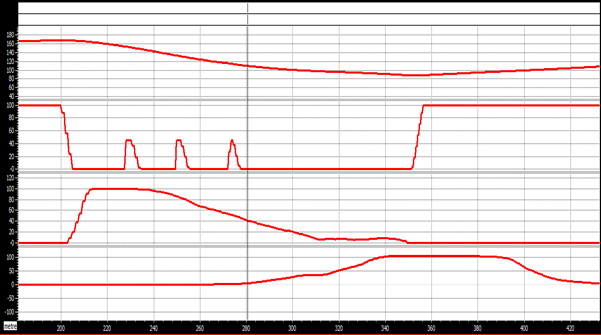
Using the data graph above, pretend you’re approaching a corner, at speed, at full throttle. The top line on the graph is speed (in MPH), the second one down is throttle position (from 0 to 100%), third line down is brake pressure, and the bottom trace is steering angle.
This illustrates the time just before you begin braking to a little after the exit or track-out point; it takes approximately five seconds That’s what I’m writing about here — just five seconds.
So, just before you brake, where are you looking? When you reach the turn-in point, how do you turn the steering wheel? As you turn in, what do you do with the brakes? When do you begin accelerating? And what do you do with the steering wheel when you do apply the throttle?
Let’s dig in and find out….
At full throttle on the straight, notice in the data graph that there is no gap between when you lifted off the throttle, and when you applied the brakes. No coasting here!
Before you even thought about lifting off the throttle and applying the brakes, you looked in towards the turn, past the turn-in point, to the EoB (End-of-Braking) point — that area of the track where your foot has come completely off the brake pedal. It’s somewhere between the turn-in point and apex. Using the EoB to judge when you begin braking (the BoB, or Begin-of- Braking) forces you to look further ahead, but more importantly, it provides your brain with the information it needs to know for when and how hard to apply the brakes.
Let’s stay with your vision for a moment. Approaching the turn-in point, your vision is moving from the point you use to reference where you initiate turning the steering to the apex, to the track-out or exit point, and scanning everything in between. Your vision is not a static thing, nor is it focused on one point, then another, then another, then another… in a steplike fashion. No, it flows forward and backward, and in between, in a smooth movement.
A reference point is not a point that you must do something at. You don’t have to have an exact point where you begin turning the steering into a corner. You might initiate your turn one car length after the end of some curbing, and in this case, the reference point is the end of the curbing, even though you don’t turn exactly at it. You reference off it. Or, as my friend Peter Krause says, you “index” off it.
Describing what you do with your eyes and where you’re looking is difficult, as it’s a constant movement. Look at the turn-in point; now, look at the apex; now, back to the turn-in point; through the apex and towards the end of the corner, or exit reference point; back to just in front of you to check your progress towards the apex; at the apex; to the exit point; at the apex again; behind the exit point; at the exit point; check line from apex to exit point; down the following straightaway; at the exit point; down the straight…. While that’s a general guide, understand that you’re constantly adapting it, and it’s not a connect-the-dots exercise. It’s a flowing scan of your vision. Your eyes move from what you’re glancing ahead towards, back to the reference point, glancing ahead, reference, glance, etc. — constantly scanning back and forth.
And that’s just what you do with your vision!
How about the brakes? As you approached the turn-in point (where the black cursor line is on the data trace below), you began to ease off the brake pedal. But notice that you had already begun releasing some pressure off the brake pedal earlier — about 40 meters (131 feet) earlier. Why? Because you were using this last portion of the brake zone to fine-tune and adjust your corner entry speed. In this case, if you’d kept the same amount of pressure on the brakes, you’d have over-slowed, so you very slightly timed the beginning of the release of the brakes to set the right corner entry speed.
But how did you know what the right corner entry speed was? Fortunately, this was not your first time through this corner! Over the past few laps, you sensed that you could turn in with a little more speed, so with each lap you’d begun to release the brakes a bit sooner until you’d found “this” speed (110 MPH at the instant you began to turn the steering!).
Also notice the three blips of the throttle during the brake zone, which are three nicely-timed downshift blips (the last one completed just before turning into the corner).
At about 312 meters, you’ll notice that the braking is almost done… but not entirely. In fact, the brake trace has what I call a “long tail.” There’s a relatively long amount of light trail braking. Why? To help the car change direction and turn into the corner — to rotate the car.
At the point where the braking is finally and totally complete, there is the tiniest amount of “nothing time,” or hesitation (some people would call it coasting) before you began to apply the throttle. And oh, what commitment to throttle it is! Look at that throttle trace. It’s entirely a steep linear progression from zero to full throttle, with no hesitation. Why? Because of the way you used the brakes to rotate the car. So the car is now pointing where you need it to be pointing, so you can commit fully to it. That’s using the brakes to help you get to full throttle sooner.
It is also interesting that the steering (bottom graph) trace shows a maximum amount of steering angle at the same time as you went to full throttle. Now, I know the concept is that to begin applying throttle, you have to begin unwinding (straightening) the steering to give some of the tires’ cornering grip to be used for acceleration. In theory, that’s what we do. But theory can be slow sometimes, especially if you’ve used the timing and rate of release of the brakes to get the car rotated so it’s pointing mostly in the direction you want to go. The main reason we can begin applying the throttle while still having steering angle in is that most cars don’t have enough acceleration capabilities to use up all the tires’ grip capacity.
By the end of this zoomed-in section of track — just one corner — you’ve used your memory and senses to set the right corner entry speed by focusing your vision and mind on the EoB, dialing in the timing and rate of release of the brakes, turned the steering with just the right rotational speed, allowed the car to change direction, followed the ideal line through the corner, picked up and committed to the throttle, unwound the steering at just the right time and rate to use all the track width, and scanned your way through the whole section of track with your vision. While doing so, you’ve made mental notes of what you could do better next lap, and stored that away in an easily-accessible part of your brain (but not too accessible so you don’t get distracted by it while driving other parts of the track). You have also noted where other cars are around you, and what you may or may not have to do with them in the next five seconds. All of that in exactly 5.06 seconds, and 250 meters (820 feet). Pretty darn amazing, us drivers, aren’t we?
Ross Bentley
/////
Ross Bentley has spent a lifetime helping drivers go faster. He’s the author of the Speed Secrets books (the best-selling racing series ever), is one of the most sought-after driver coaches in the world, and runs SpeedSecrets.com, the largest collection of driver development resources anywhere. Want more articles like this? Subscribe at RossBentley.Substack.com.