


A certified racing baselayer adds 4 to 5 seconds of additional thermal protection time on top of your suit. Your suit alone — properly homologated to FIA 8856-2018 or SFI — gives you roughly 10 seconds from direct flame exposure to second-degree burns reaching your skin. Add a certified baselayer underneath and that window extends to 14 or 15 seconds. For a driver trying to get out of a car that is on fire, that is not a marginal difference. That is the outcome.
Most drivers know they should have a racing baselayer. Far fewer understand exactly why it works, what to look for when buying one, or what happens to the protection when you take care of it wrong. This covers all of it.
Why does a racing baselayer add protection?
There are three things working together to create that additional window, and it is worth understanding all three because they each have implications for what you buy and how you maintain it.
The first is the fabric itself. A certified racing baselayer is made from Nomex, which is the material of choice across professional motorsport because it does not ignite, melt, or drip when exposed to direct flame. Instead it chars in place, and that charring creates a physical barrier between the heat source and your skin that continues to slow heat transfer even as the fire works on it. This is fundamentally different from a synthetic or cotton base layer, which will melt or ignite and make the situation significantly worse.
The second is certification. FIA 8856-2018 and SFI 3.3 are not marketing labels — they are tested, verified standards that confirm the garment performs to a specific thermal protection threshold under controlled conditions. A cheap or uncertified product may look identical on the hanger and feel similar against your skin, but it has not been validated to perform when it matters, which is the only moment the performance is relevant.
The third is the air gap. When you wear a baselayer under your suit, two layers of fire-rated material create a physical space between them that traps air. Air is a natural insulator, and that insulating layer slows the rate at which heat transfers from the outer suit through to your skin. Remove any one of these three elements — the certified fabric, the validated standard, or the second layer — and the protection window shrinks. That is the full answer to why a racing baselayer works, and why a cheap uncertified alternative does not replicate it even when it appears to.
What should a racing baselayer system include?
A complete racing baselayer system is four pieces: TOP, PANTS, HOOD, and SOCK. Most drivers buy the top and pants and skip the hood, which leaves a gap in the system that is easy to overlook and genuinely consequential.
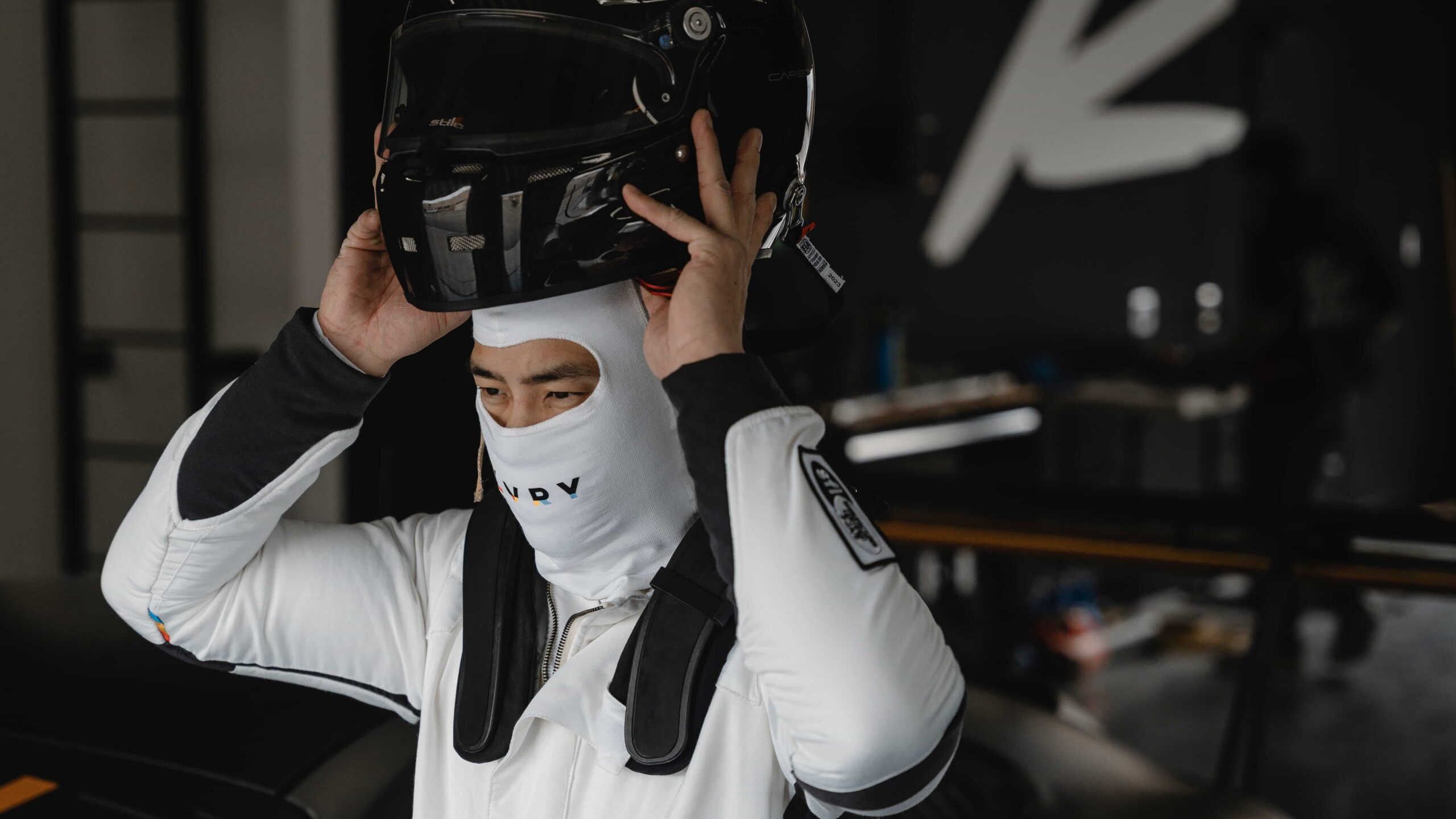
Your suit collar and your helmet create an exposed area at the head and neck that neither piece fully covers on its own. In a cockpit fire that area is the most vulnerable on your body, and the hood exists specifically to close it. It is designed to contour to your head and neck, sit seamlessly under a helmet without creating pressure points, and complete the thermal barrier that the rest of the system creates. Wearing the top and pants without the hood is like running a fire suppression system with one nozzle disconnected — most of it is working, but the gap is the part that matters. And at the other end of the system, the DRVR SOCK completes the picture — ultra-lightweight, FIA 8856-2018 certified, and thin enough that pedal feel stays completely transparent.
The DRVR baselayer system — top, pants, hood, and sock — is built from single-layer Nomex and carries dual homologation to both FIA 8856-2018 and SFI 3.3. Dual certification matters because series requirements vary across sanctioning bodies, and the last thing you want is to discover at scrutineering that the product you have does not satisfy the standard being enforced that weekend. Beyond the safety credentials, the system is engineered to actually be wearable across a full race weekend — an athletic cut with enough elasticity for full cockpit mobility, moisture-wicking fabric to manage heat and sweat over a long stint, and a lightweight profile that disappears under the suit rather than adding bulk or creating restriction.
Does it matter how you wash a racing baselayer?
Yes, significantly, and this is the part of baselayer ownership that almost no one talks about clearly enough.
Standard household detergents contain animal fats and surfactants. On everyday fabrics those compounds are harmless. On Nomex they are damaging in a way that is invisible and irreversible. When animal fats bond with Nomex fibers — which they do readily, because the material is absorbent — the fats increase the combustibility of the fabric. The gear you bought to resist fire becomes more flammable after a single wash with the wrong product. At the same time, the homologation degrades in a way that cannot be undone, meaning the certification that validates your protection no longer applies to the garment in the same way.
None of this is visible. The garment looks the same, feels the same, and gives you no indication that anything has changed. It just no longer performs to the standard you paid for, and you will find out at the worst possible time.
The correct approach is straightforward:
- Never wash fire-rated gear with regular household detergent
- Use a specialist detergent designed for technical and fire-rated fabrics
- Handwash in cold water only
- Air dry — keep fire-rated gear out of the tumble dryer entirely
This is not overcautious maintenance advice. It is the baseline required to keep the protection active.
How long does a racing baselayer last?
This is the question most drivers do not ask often enough. The honest answer is that fire-rated gear degrades over time through a combination of wash cycles, UV exposure, physical wear, and — if it has been washed incorrectly even once — chemical degradation that cannot be seen or reversed.
A lot of club racers fall into the pattern of buying the least expensive baselayer available and running it for as long as possible, which is understandable given the cost of a full race kit but genuinely counterproductive when it comes to safety equipment. The baselayer is the least expensive meaningful safety purchase relative to what it protects. A helmet costs more. A suit costs more. A HANS device costs more. None of them function correctly without a properly maintained certified layer underneath, which means treating the baselayer as a consumable worth replacing on a reasonable cycle is not an extravagance — it is a straightforward extension of the investment you have already made in everything else.
Wash it correctly every time. Replace it before you feel like you need to. Use the full system. Those three things are the difference between the protection you paid for and the protection you actually have.
The short answer for anyone who wants it
A certified racing baselayer adds 4 to 5 seconds of thermal protection on top of your suit by combining fire-resistant Nomex fabric, verified homologation to FIA 8856-2018 and SFI 3.3, and the insulating air gap created between two layers of fire-rated material. The full system is top, pants, and hood — all three are required to close the protection gap at the head and neck. Wash it with a specialist detergent like Molecule, handwash cold, air dry, and replace it on a regular cycle. Every second in that window counts. This is how you protect them.
Shop the DRVR baselayer system — top, pants, hood and sock — at lvry.co.