
Do you really believe you can improve your driving?
Before reading beyond this paragraph, I’d like you to stop and take as long as it takes to answer this one question:
“What is the one technique, skill, or behavior that I just can’t seem to overcome with my driving?”
Keep this focused on the act of driving — your act of driving. Okay? Stop reading and think about this.
Hang on. Have you really stopped and thought about it? Do you have a solid, specific, well-thought-out answer to the question, “What is the one technique, skill or behavior that I just can’t seem to overcome with my driving?”
I’ll wait right here for you to answer that question. I’m not going anywhere.
Okay, now that you’ve answered the question, let’s poke away at your answer (and, of course, I don’t know what your answer is).
But before we move on, here’s another question: Do you have a physical or mental limitation that makes it impossible to accomplish whatever your answer is? Before you answer that question, let me tell you a short story.
A few years ago, I talked with three people for episode #182 of my Speed Secrets Podcast: Jay St. Claire, Colin Pascik, and Aaron Brooks. They talked amongst themselves about Ranger Road, a program that puts wounded military veterans behind the wheels of race cars for LeMons races. After we ended the recorded part of our conversation, Colin mentioned that he was going out to shovel the two feet of snow off his 400-foot driveway. Oh, and he has prosthetic legs, having had his legs blown off in combat overseas. He had done his first race at Thunderhill a year or so prior, having never driven on a race track previously. Yes, he’d never driven on track, but got behind the wheel with hand controls, and went racing. So, when you’re answering the question about physical or mental limitations which may restrict you from being able to accomplish something, think about Colin.
A lot of what we think is impossible is actually possible. Do you believe that it’s possible to walk barefooted on white hot coals? Thousands of people do this each and every year as part of a Tony Robbins program. It’s not just possible, it’s done so often that it’s almost normal — even if you don’t think that walking on white hot coals is normal or smart!
In his book, The Art of Impossible, Steven Kotler shared what one of his mentors said to him, “Very little is impossible with ten years of practice.”
Okay, enough about what is and isn’t impossible, and back to your answer to, “What is the one technique, skill or behavior that I just can’t seem to overcome with my driving?”
Which comes first, the ability to do something or the belief you can do that something? If you answered “the ability,” then how do you do something that you don’t believe you can do? If you answered “the belief,” then how do you develop the belief you can do something if you’ve never done it before? It’s the classic chicken and egg scenario, right?
“What is the one technique, skill or behavior that I just can’t seem to overcome with my driving?” It’s possible that what’s stopping you from doing this is your belief that you can’t do it (even if it’s a tiny, little, deep-down-inside belief so far back in your mind that you don’t even realize it was there).
Using the example of taking a fast corner at full throttle (that other drivers can do in the same car and conditions), do you have the ability to do that? I’m sure you do. If you can hold your foot flat to the floor on the gas pedal on a straightaway, then you have the physical ability to do the same thing in that fast corner. So, it’s a mental thing, right?
How many things did you once think were impossible, but you do on a somewhat regular basis, now? Or, even if you didn’t think they were impossible, you had a hard time imagining yourself doing them? There was a time that I not only thought that I’d never be able to stand and talk in front of a group of people, but I absolutely knew that to be true. Today, it’s not only possible that I can do it, but I do it all the time.
I’d like you to really think about this, and even write your answers down. Yes, take a few minutes to write down what you once doubted that you’d be able to do, and yet you currently do often.
I’m waiting, again, for you to do your “article-work” (kinda like homework, but it’s something you do in the middle of reading an article — and yes, I just made that up!). Write down what you once doubted, but today do often. For me, I wrote down that I make presentations and talks to hundreds of people, where once I’d rather die than do that.
Progress is what we’re really after, isn’t it? Yeah, sure, it would be awesome if the first time we did something, we mastered it, but that’s not realistic. It would also be unrewarding if we were able to do this so easily.
If we approach this from the angle that we can’t do something without having the belief we can do it, how can we believe something before doing it?
I’ve coached many, many drivers who came to motorsport later in life, in their 30s, 40s, 50s, or 60s. While they didn’t plan to become F1 or Indy car champions, they did want to be as good as they could possibly be at whatever level and type of motorsport they chose (they wouldn’t have hired a coach if they didn’t want this). These have usually been people who have been successful in other parts of their lives (business, other sports, etc.), prior to jumping into a car and driving fast around a race track. Some picked it up more quickly than others. Some struggled a little at first, and then made big gains. Looking back at every one of them, two things stood out that made them successful in their newly-found driving “career”: the desire to learn and improve, and a belief that they could do it.
When a person shows up to take on high-performance or race driving with a belief that goes something like this, “I’ve been successful in many things in my life, and I’m especially good at ____, so I can also be good at driving fast,” that helps. A lot.
Changing your beliefs is a process, and it’s a gradual one that takes time. I’m not saying it’s going to take the ten years that Steven Kotler’s mentor referenced. It could take days, weeks, or months, but if you put the effort into changing your beliefs, it will happen. And that’s the key to overcoming that one thing that you identified with the question, “What is the one technique, skill or behavior that I just can’t seem to overcome with my driving?”
How?
Here’s the plan I’d suggest you follow.
- Seven days a week, spend a minimum of fifteen minutes, twice a day, doing a mental imagery session. You can do one in the morning and one just before bed at night, one in the afternoon and one before bed, one after dinner and one before bed, or whenever (notice I’m suggesting you always do one before bed, and that’s because what you imagine at that time will sink in even more while you’re asleep). There should be at least one hour in between the two sessions. You should also determine one consistent place to do them. Preferably this is not lying on your bed, as there is too much of a tendency to fall asleep while doing it (if you feel yourself drifting off to sleep, take 2 or 3 deep, quick breaths). Sitting in a chair is good; sitting in your race car is even better. You want to make sure you’re comfortable, relaxed, it’s quiet, and you won’t be disturbed.
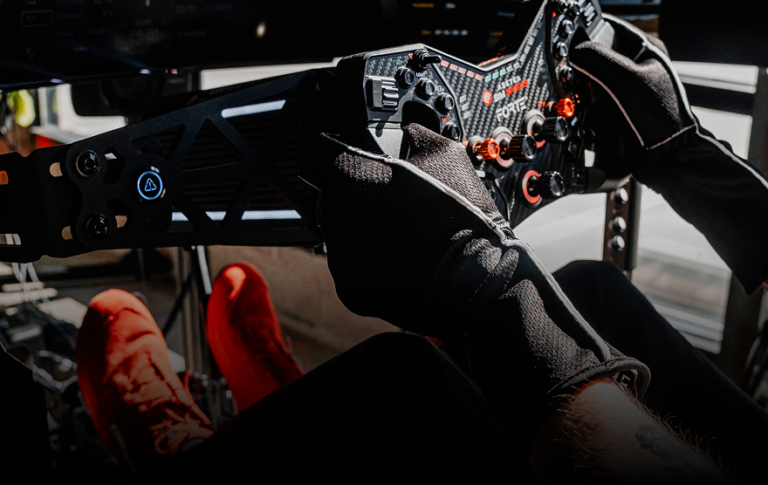
- The more you use your body, the more the session will program the muscle memory to do things correctly when on the track. Use as many “props” as you can to make it the most realistic. You can wear your helmet, hold a real steering wheel, work the pedals, etc. And, be prepared to use your visual, kinesthetic (feel), and auditory senses. This process will not be as effective if you only use your visual sense, if you only imagine what you see.
- Prepare and read over a short narrative that outlines the part of your driving that you want to overcome (it can just be a few bullet points, or a fully written out narrative — use the section below as a starting point). Writing out a plan for your narratives will make sure you stay on task. The only way for this programming to be really effective is to repeat it enough times — repetition is critical. If you begin to stray from what you’ve outlined in your narrative, you will not be repeating the session enough times to make the difference.
- After you’ve read through the narrative and you’ve got it memorized enough to be able to follow it over and over again for fifteen minutes, prepare for your imagery session. To begin, get yourself in position, close your eyes and breathe deeply and slowly. Relax. Feel yourself relaxing. Feel your muscles begin to let go. Feel yourself begin to sink into your chair or seat. Listen to your heartbeat slow down. Notice your breathing slow down, become even more relaxed. Imagine yourself relaxing and sinking into your chair or seat. Breathe. Relax your muscles. Breathe.
- Your objective is to get into an Alpha-Theta brainwave state, where your mind has slowed down and is in a very receptive state. It’s near that state just before you fall asleep, but you’re still awake enough to be aware of what’s going on around you. This will usually take anywhere from two to five minutes to get to this state (it will probably take less and less time with practice).
- Breathe. Relax. As you do each of these imagery sessions, continue to breathe and be relaxed. Part of what you’re programming is the ability to feel relaxed and continue to breathe throughout these scenarios. Breathe. Relax.
- You’re now ready to begin a mental imagery session, programming what you prepared in the narrative, and using multiple senses.
Use the following text as a starting point when writing out your own narrative, filling in the bullet points with your own words.
“Sit up straight in your chair, making yourself comfortable. Close your eyes. Breathe deeply, taking nice, slow breaths. Notice your breath – inhale and exhale. Relax your body. Allow your muscles to relax. Feel your feet relax. Feel your legs relax. Feel your hands relax. Feel your arms relax. Feel your neck and shoulders relax. Feel your torso relax. Feel your body sink into the chair. Feel your body get heavy and relaxed. Hear your heartbeat slow down. Continue to breathe slowly and deeply. If you feel yourself start to drift off to sleep, just take two or three quick, deep breaths and that will bring you back to a relaxed but awake state. Breathe slowly. Relax your muscles.
“Breathe. Relax.
[Add your specific narration/bullet pointed outline here, answering the question, “What is the one technique, skill or behavior that I just can’t seem to overcome with my driving?” Imagine doing exactly what you’ve been struggling with.]
“As you imagine yourself in this setting, notice the expression you have on your face. Notice your body posture. How do you feel? Do you feel confident, happy, focused, ready?
“Enjoy the feeling of your imagery….”
If you do this seven days a week, your belief in your ability to do whatever it is you want to do will change — for the better — as well as your physical ability to do what it is you want to do. Of course, it’s not an off-on switch. Rather, it’s a spectrum, and over time, your belief and abilities will slide towards the end of the scale that represents knowing deep down inside that you can do what you want to do.
If you’re able to physically drive on track at certain times during the days/weeks/months that you’re following this mental programming plan, the results on the track will reinforce what you’re doing at home. It may be subtle at first, and it can even feel as though you’re going backward at times (one step back for two steps forward), but your programming will change over time.
Believe me, it will.
Ross Bentley
/////
Ross Bentley has spent a lifetime helping drivers go faster. He’s the author of the Speed Secrets books (the best-selling racing series ever), is one of the most sought-after driver coaches in the world, and runs SpeedSecrets.com, the largest collection of driver development resources anywhere. Want more articles like this? Subscribe at RossBentley.Substack.com.